splash
Papers released in the second LtU splash on June 9, 2026.
2026
-
 Shy Genel, Yongseok Jo, Boon Kiat Oh , and 10 more authorsarXiv e-prints, Jun 2026
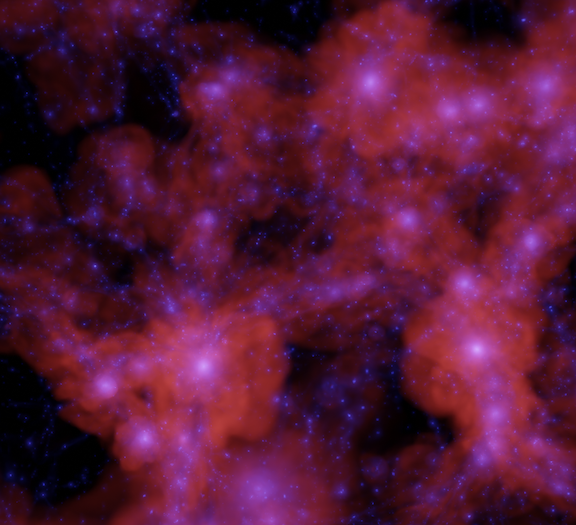
We present a new set of 1,192 cosmological simulations as part of the CAMELS project, exploring a space of 35 cosmological, astrophysical, and numerical parameters around the fiducial IllustrisTNG model in volumes of (50 Mpc/h)^3, eight times larger than previous CAMELS simulations, providing lower sample variance and access to more massive halos and more diverse environments. Using matter power spectra, projected maps, galaxy spatial graphs, and halo thermodynamical properties as inputs to multilayer perceptrons, convolutional neural networks, graph neural networks, and Gaussian processes, we find that the larger volumes generally yield tighter marginal parameter constraints, though improvements scale more weakly than the square root of the volume increase, which we interpret as arising from mode-coupling information loss or complex parameter degeneracies. We also characterize the effects of four new parameters controlling the amplitude and timing of the ionizing background radiation on intergalactic medium temperature statistics, and publicly release all simulation outputs and ancillary data.
@article{2026arXiv260610038G, author = {{Genel}, Shy and {Jo}, Yongseok and {Oh}, Boon Kiat and {Tillman}, Megan Taylor and {Lee}, Max E. and {Lee}, Jun-Young and {Hern{\'a}ndez-Mart{\'\i}nez}, Elena and {Lovell}, Christopher C. and {Sims}, Xavier and {Burkhart}, Blakesley and {Nagamine}, Kentaro and {Angl{\'e}s-Alc{\'a}zar}, Daniel and {Villaescusa-Navarro}, Francisco}, title = {{Learning the Universe with the 2nd Generation of CAMELS: Varying 35 parameters of the IllustrisTNG model in (50 Mpc/h)³ boxes}}, journal = {arXiv e-prints}, keywords = {Cosmology and Nongalactic Astrophysics, Astrophysics of Galaxies}, year = {2026}, month = jun, eid = {arXiv:2606.10038}, pages = {arXiv:2606.10038}, archiveprefix = {arXiv}, eprint = {2606.10038}, primaryclass = {astro-ph.CO}, adsurl = {https://ui.adsabs.harvard.edu/abs/2026arXiv260610038G}, adsnote = {Provided by the SAO/NASA Astrophysics Data System}, } -
 Jonathan Kho, Aklant K. Bhowmick, Rainer Weinberger , and 8 more authorsarXiv e-prints, Jun 2026
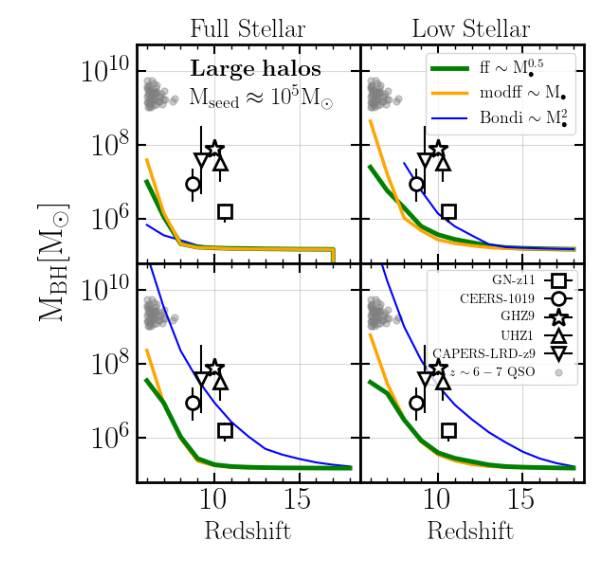
JWST discoveries of the earliest (z ≥ 9) supermassive black holes (M_• ≥ 10^6 M_☉) challenge the BH seeding and accretion models of most cosmological simulations. In this work, we compare early BH growth arising from three different accretion prescriptions characterized by distinct scalings between the accretion rate (Ṁ_•) and the BH mass (M_•): the commonly used Bondi–Hoyle model (Ṁ_• ∝ M_•^2), and two free-fall models with shallower scalings (Ṁ_• ∝ M_•^1/2 and M_•). Bondi accretion tends to produce stronger runaway growth than the free-fall models when using heavy ( 10^5 M_☉) seeds owing to the steeper M_• scaling, but its sensitivity to the local gas sound speed makes it more susceptible to suppression from temperature increases due to AGN and stellar feedback. The free-fall models tend to produce stronger growth for lower-mass seeds ( 10^3–10^4 M_☉) as they are less dependent on the BH’s mass to accrete effectively, however in this regime BH growth remains negligible for all accretion models in the presence of fiducial stellar feedback. Enhancing early BH growth via many BH–BH mergers disproportionately enhances subsequent accretion-driven growth for Bondi due to the steeper M_• dependence. Our simulations can thus assemble BHs with masses of 10^6–10^7 M_☉ at z ≥ 9, as inferred by JWST, under two circumstances: 1) abundant heavy-seed formation that drives BH–BH mergers, or 2) Bondi accretion with weak feedback.
@article{2026arXiv260610036K, author = {{Kho}, Jonathan and {Bhowmick}, Aklant K. and {Weinberger}, Rainer and {Torrey}, Paul and {Blecha}, Laura and {Hernquist}, Lars and {Bryan}, Greg L. and {Garcia}, Alex M. and {Ahvazi}, Niusha and {Saravia}, Alejandro and {Oh}, Boon Kiat}, title = {{Learning the Universe at High Redshifts: Impact of Accretion Modeling on Early Black Hole Growth}}, journal = {arXiv e-prints}, keywords = {Astrophysics of Galaxies}, year = {2026}, month = jun, eid = {arXiv:2606.10036}, pages = {arXiv:2606.10036}, archiveprefix = {arXiv}, eprint = {2606.10036}, primaryclass = {astro-ph.GA}, adsurl = {https://ui.adsabs.harvard.edu/abs/2026arXiv260610036K}, adsnote = {Provided by the SAO/NASA Astrophysics Data System}, } -
 Ulrich P. Steinwandel, Stuart McAlpine, Richard Stiskalek , and 7 more authorsarXiv e-prints, Jun 2026
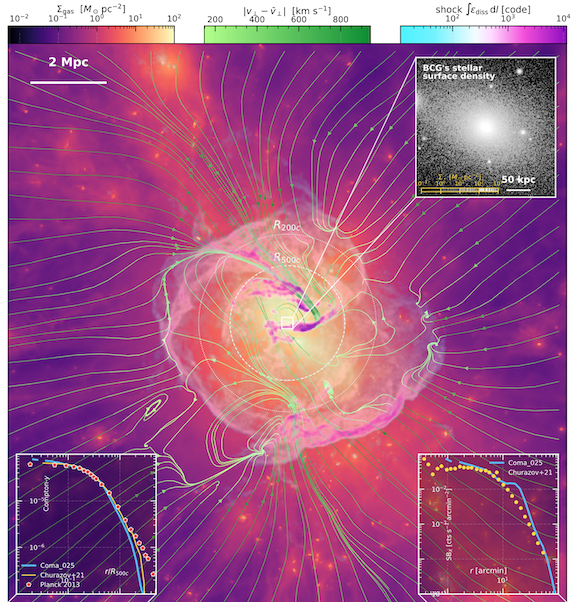
We present a suite of 50 high-fidelity simulations of Coma cluster analogues constructed from BORG/MANTICORE constrained initial conditions and evolved with the IllustrisTNG galaxy formation model. Regions predicted to form massive clusters comparable to Coma in mass and environment are selected and followed through cosmic time, producing realistic galaxy populations and intracluster medium properties. The ensemble captures both cosmic variance and uncertainties in the local initial conditions, providing a statistically robust framework for interpreting Coma in a cosmological context. We focus on direct comparisons with observed thermodynamical profiles of the intracluster medium. Specifically, we extract X-ray surface brightness profiles from the simulated clusters and confront them with measurements from eROSITA, as well as compute the thermal Sunyaev–Zel’dovich effect via integrated Compton-y profiles for comparison with Planck satellite data. The simulations reproduce the broad shape and normalisation of both observables, while also highlighting the range of scatter expected from environmental and assembly history differences. This enables us to assess how feedback processes, merger activity, and large-scale environment shape observable cluster properties. Our results demonstrate that combining constrained cosmological initial conditions with state-of-the-art galaxy formation physics provides an effective strategy for generating targeted, observation-driven analogues of specific clusters. The resulting dataset offers a valuable resource for testing models of intracluster medium physics, calibrating scaling relations, and interpreting upcoming joint X-ray and Sunyaev–Zel’dovich observations of nearby massive clusters.
@article{2026arXiv260610028S, author = {{Steinwandel}, Ulrich P. and {McAlpine}, Stuart and {Stiskalek}, Richard and {Pakmor}, R{\"u}diger and {Springel}, Volker and {Churazov}, Eugene and {Khabibullin}, Ildar and {Jasche}, Jens and {Lavaux}, Guilhem and {Bryan}, Greg L.}, title = {{Learning the Universe: Constrained simulations of the Coma galaxy cluster -- I. Radial X-ray and Compton-y signatures}}, journal = {arXiv e-prints}, keywords = {Cosmology and Nongalactic Astrophysics, Astrophysics of Galaxies}, year = {2026}, month = jun, eid = {arXiv:2606.10028}, pages = {arXiv:2606.10028}, archiveprefix = {arXiv}, eprint = {2606.10028}, primaryclass = {astro-ph.CO}, adsurl = {https://ui.adsabs.harvard.edu/abs/2026arXiv260610028S}, adsnote = {Provided by the SAO/NASA Astrophysics Data System}, } -
 Laura Sommovigo, Deaglan J. Bartlett, Rachel K. Cochrane , and 3 more authorsarXiv e-prints, Jun 2026
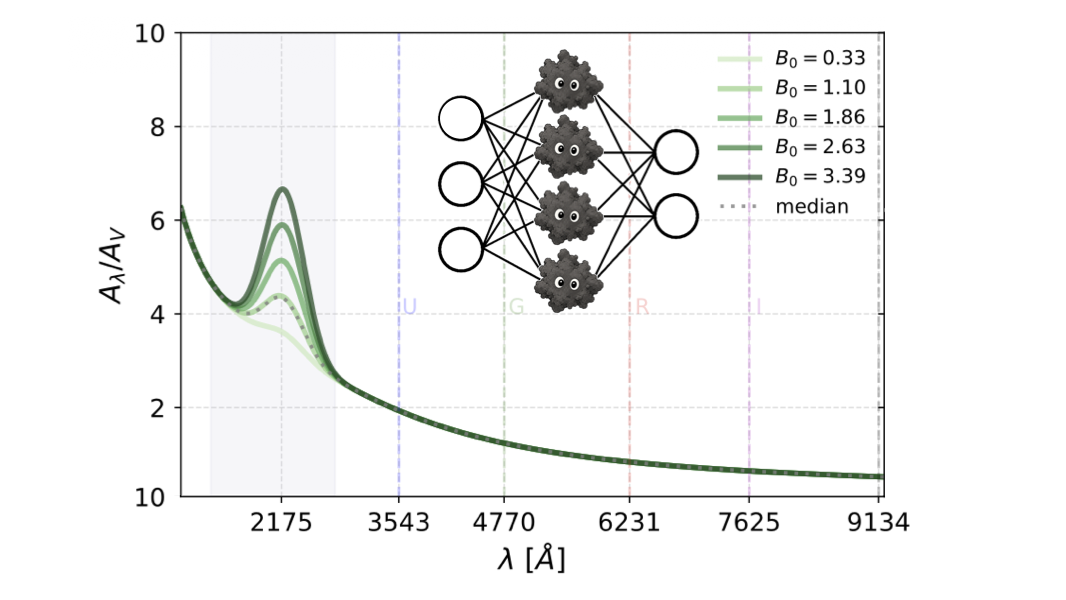
Dust attenuation is a major source of systematic uncertainty in both SED fitting and forward modeling of galaxy populations, yet the functional form used to parameterize attenuation curves has received surprisingly little systematic scrutiny. Using a large library of synthetic attenuation curves from TNG50 and TNG100 galaxies post-processed with the SKIRT radiative transfer code under three dust mixtures (Milky Way, SMC, and stellar dust), we show via Information-Ordered Bottleneck analysis that exactly four parameters are needed to capture the diversity of attenuation curve shapes, and use symbolic regression to derive a new interpretable four-parameter model that outperforms existing parameterizations in recovering both attenuation curves and emergent fluxes. The four parameters – UV bump strength, FUV slope, UV-bump transition curvature, and large-scale optical slope – are primarily regulated by star-formation rate surface density, metallicity, and stellar–dust geometry, and we provide symbolic-regression scaling relations linking them to quasi-observable galaxy properties for use in SED fitting and forward modeling without radiative-transfer calculations.
@article{2026arXiv260610027S, author = {{Sommovigo}, Laura and {Bartlett}, Deaglan J. and {Cochrane}, Rachel K. and {Ho}, Matthew and {Lovell}, Christopher C. and {Somerville}, Rachel S.}, title = {{Learning the Universe: The Structure of Dust Attenuation Curves in Galaxy Simulations}}, journal = {arXiv e-prints}, keywords = {Astrophysics of Galaxies, Cosmology and Nongalactic Astrophysics, Instrumentation and Methods for Astrophysics}, year = {2026}, month = jun, eid = {arXiv:2606.10027}, pages = {arXiv:2606.10027}, archiveprefix = {arXiv}, eprint = {2606.10027}, primaryclass = {astro-ph.GA}, adsurl = {https://ui.adsabs.harvard.edu/abs/2026arXiv260610027S}, adsnote = {Provided by the SAO/NASA Astrophysics Data System}, } -
 Sarah M. R. Jeffreson, Eve C. Ostriker, Chang-Goo Kim , and 1 more authorarXiv e-prints, Jun 2026
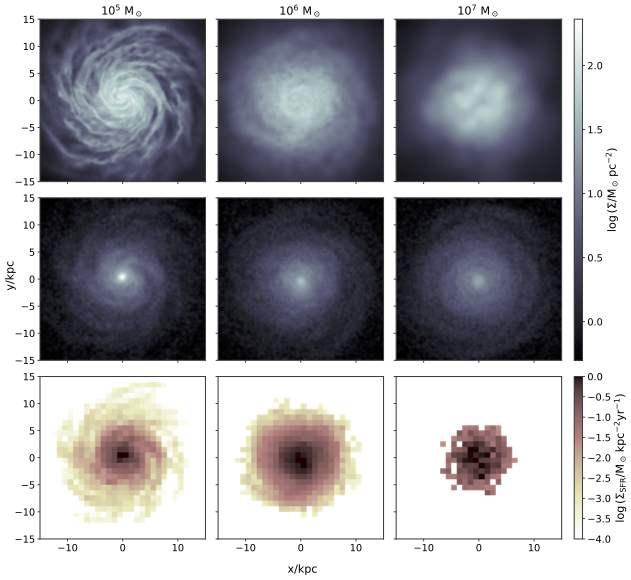
We present a new subgrid model for interstellar gas evolution in cosmological simulations of galaxy formation, based on the pressure-regulated, feedback-modulated (PRFM) theory of star formation. In contrast to the empirically pegged star formation prescriptions employed in current cosmological simulations, the PRFM model links the local star formation rate to the dynamic balance achieved in galactic interstellar gas between gravity and stellar feedback effects. With this formulation, both the star formation efficiency and the effective equation of state may be directly calibrated using numerical simulations, such as TIGRESS, which resolve physics of the interstellar medium and star formation at parsec scales. We develop, and implement in the Arepo moving-mesh code, two complementary classes of the subgrid model: a volumetric version (PRFM-vol) applicable when the gas disk scale height of a galaxy is numerically resolved in a simulation, and an integrated version (PRFM-int) that reconstructs the mid-plane density and pressure from vertical equilibrium considerations when the true gas scale height cannot be numerically resolved. Using isolated Milky-Way-like disk simulations across mass resolutions 10^5–10^7 M_☉, we show that both implementations yield shorter gas depletion times than the IllustrisTNG prescription, especially in regions where pressure and density are large. At high resolution, PRFM-vol and PRFM-int agree closely with each other and with TIGRESS for the star formation rate; PRFM-int remains robust at all resolutions tested. These results demonstrate that PRFM-derived subgrid prescriptions provide a physically grounded and numerically stable framework for star formation across the dynamic range of galaxy formation simulations, paving the way for future cosmological applications.
@article{2026arXiv260610026J, author = {{Jeffreson}, Sarah M.~R. and {Ostriker}, Eve C. and {Kim}, Chang-Goo and {Burger}, Jan}, title = {{Pressure-regulated feedback-modulated star formation as a subgrid model for galaxy formation simulations}}, journal = {arXiv e-prints}, keywords = {Astrophysics of Galaxies, Cosmology and Nongalactic Astrophysics}, year = {2026}, month = jun, eid = {arXiv:2606.10026}, pages = {arXiv:2606.10026}, archiveprefix = {arXiv}, eprint = {2606.10026}, primaryclass = {astro-ph.GA}, adsurl = {https://ui.adsabs.harvard.edu/abs/2026arXiv260610026J}, adsnote = {Provided by the SAO/NASA Astrophysics Data System}, } -
 Richard Stiskalek, Lucia A. Perez, Shy Genel , and 3 more authorsarXiv e-prints, Jun 2026
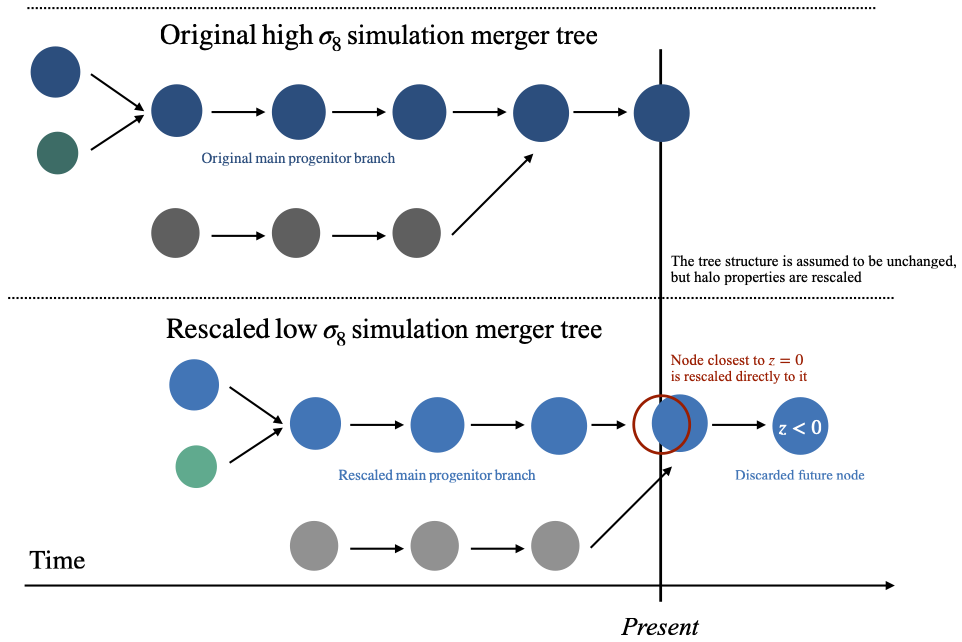
Semi-analytic models offer an inexpensive alternative to hydrodynamical simulations for learning cosmology from galaxy surveys, but densely sampling cosmological parameters in sufficient volume remains expensive due to the need for N-body merger trees. We extend cosmological rescaling to operate directly on merger trees in the Ω_m–σ_8 plane, running the Santa Cruz semi-analytic model on rescaled trees to produce galaxy populations at new cosmological and astrophysical parameters at negligible cost, with a novel halo-profile-based correction suppressing systematic bias in rescaled halo masses to below the per cent level. Applied to parameter estimation from the stellar mass function and two-point correlation function, we find that as few as 64 base N-body simulations rescaled to 1000 training samples match the accuracy of 750 dedicated simulations, with rescaling to 3200 realisations improving Ω_m predictions by 25%, at a cost of 0.1 CPUh per simulation versus several thousand CPUh for a dedicated run.
@article{2026arXiv260610024S, author = {{Stiskalek}, Richard and {Perez}, Lucia A. and {Genel}, Shy and {Somerville}, Rachel S. and {Angulo}, Raul E. and {Contreras}, Sergio}, title = {{Learning the Universe with cosmological rescaling of merger trees and semi-analytic galaxy formation models}}, journal = {arXiv e-prints}, keywords = {Cosmology and Nongalactic Astrophysics, Astrophysics of Galaxies}, year = {2026}, month = jun, eid = {arXiv:2606.10024}, pages = {arXiv:2606.10024}, archiveprefix = {arXiv}, eprint = {2606.10024}, primaryclass = {astro-ph.CO}, adsurl = {https://ui.adsabs.harvard.edu/abs/2026arXiv260610024S}, adsnote = {Provided by the SAO/NASA Astrophysics Data System}, } -
 Ludvig Doeser, and Jens JaschearXiv e-prints, Jun 2026
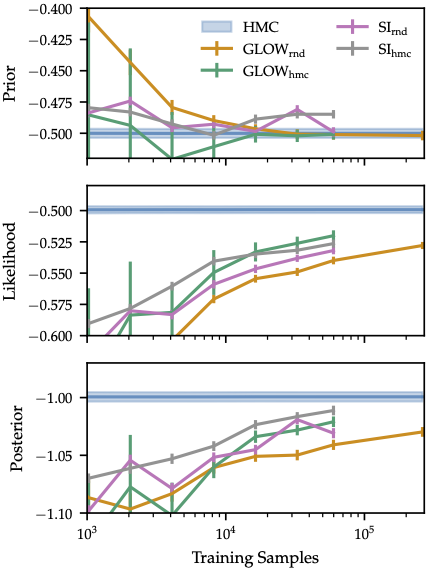
Accurate posterior estimation is central to scientific inference, as uncertainties determine what can be reliably learned from observational data. While Markov chain Monte Carlo methods provide asymptotic convergence guarantees, they are computationally demanding in high-dimensional settings. Neural network–based generative models for entire discretized 3D fields enable fast amortized inference but often lack convergence guarantees and principled accuracy assessment. Using Hamiltonian Monte Carlo to obtain reference posterior samples, we conduct a controlled field-level evaluation of an implicit generative model (Stochastic Interpolants) and an explicit likelihood-based model (GLOW normalizing flows). This comparison, unavailable in typical applications, enables the detection of posterior geometry failures that standard metrics cannot capture. As a case study, we consider the cosmological inverse problem of inferring cosmic initial conditions from present-day large-scale structure. To match the precision of modern cosmological data, this problem increasingly relies on complex, non-linear, and non-differentiable simulators, which are incompatible with gradient-based inference frameworks. Generative models offer a route to address these challenges, provided their inferred posteriors are reliable. In this work, we show that matching posterior means, marginal distributions, or achieving high cross-correlation does not imply correct uncertainty structure, as revealed by posterior variance fields and sample-based evaluations. Through this work, we aim to raise awareness of the challenges of uncertainty estimation in high-dimensional field-level settings, highlighting the importance of careful design and validation of neural generative approaches for scientific applications.
@article{2026arXiv260610023D, author = {{Doeser}, Ludvig and {Jasche}, Jens}, title = {{Learning the Universe: Posterior Reliability of Neural Generative Models in High-Dimensional Field-Level Inference of Cosmic Initial Conditions}}, journal = {arXiv e-prints}, keywords = {Cosmology and Nongalactic Astrophysics, Instrumentation and Methods for Astrophysics, Machine Learning}, year = {2026}, month = jun, eid = {arXiv:2606.10023}, pages = {arXiv:2606.10023}, archiveprefix = {arXiv}, eprint = {2606.10023}, primaryclass = {astro-ph.CO}, adsurl = {https://ui.adsabs.harvard.edu/abs/2026arXiv260610023D}, adsnote = {Provided by the SAO/NASA Astrophysics Data System}, } -
 Jan D. Burger, Volker Springel, Eve C. Ostriker , and 7 more authorsarXiv e-prints, Jun 2026
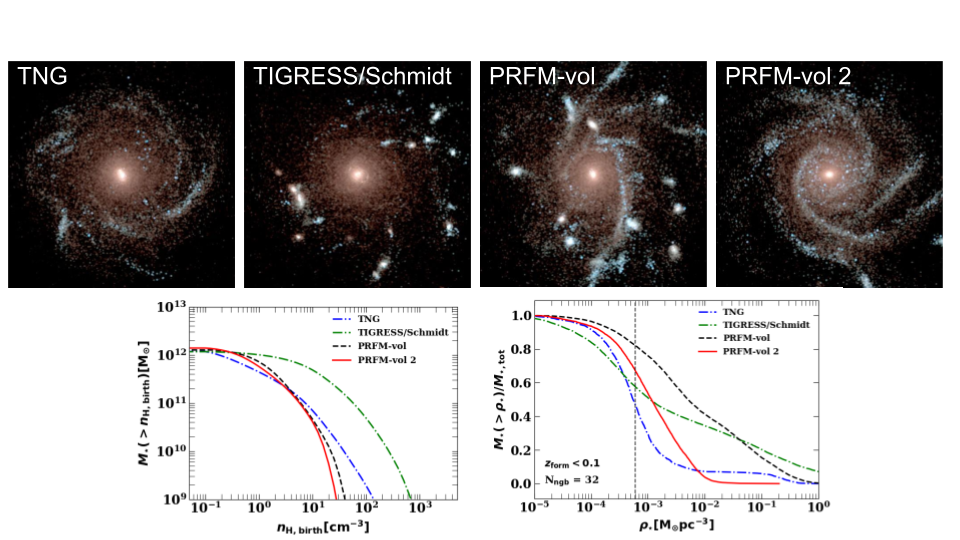
We introduce PRFM-vol, a new subgrid model for star formation in cosmological simulations that aims to increase the physical realism of cosmological simulations by leveraging results obtained with focused ISM simulations. We deploy a modified effective equation of state and calculate the star formation rate for each gas cell as a function of the ambient densities of gas, dark matter, and stars, based on the pressure-regulated feedback-modulated (PRFM) theory of star formation. Test simulations of our model in isolated galaxies show that we match PRFM predictions and TIGRESS scaling relations remarkably well, provided sufficiently high resolution is available. In particular, we are able to clearly demonstrate the impact of the stellar potential on the star formation rate, thereby retaining an important prediction of PRFM. We then apply our new model to cosmological multizoom simulations and find, compared to our previous TIGRESS/Schmidt model, a significant increase in the stellar scale heights and a slight increase in stellar mass. We demonstrate that modifying the effective equation of state significantly affects the morphology of simulated galaxies. Pronounced stellar clumps appear if the effective pressure at low hydrogen number densities is low, and disappear for higher pressure. We show that the formation of clumps is a result of Toomre instabilities, and conclude that simulated galaxy morphologies can be used to constrain effective equation of state models. Overall, our results establish PRFM-vol as a new self-consistent, physics-motivated subgrid model for star formation in high-resolution cosmological simulations.
@article{2026arXiv260610022B, author = {{Burger}, Jan D. and {Springel}, Volker and {Ostriker}, Eve C. and {Kim}, Chang-Goo and {Steinwandel}, Ulrich and {Smith}, Matthew C. and {Hernquist}, Lars and {Bryan}, Greg L. and {Somerville}, Rachel S. and {Gurman}, Alon}, title = {{Learning the Universe with PRFM-vol: Introducing a new subgrid model for star formation in cosmological simulations}}, journal = {arXiv e-prints}, keywords = {Astrophysics of Galaxies}, year = {2026}, month = jun, eid = {arXiv:2606.10022}, pages = {arXiv:2606.10022}, archiveprefix = {arXiv}, eprint = {2606.10022}, primaryclass = {astro-ph.GA}, adsurl = {https://ui.adsabs.harvard.edu/abs/2026arXiv260610022B}, adsnote = {Provided by the SAO/NASA Astrophysics Data System}, } -
 Stuart McAlpine, Jens Jasche, Guilhem Lavaux , and 2 more authorsarXiv e-prints, Jun 2026
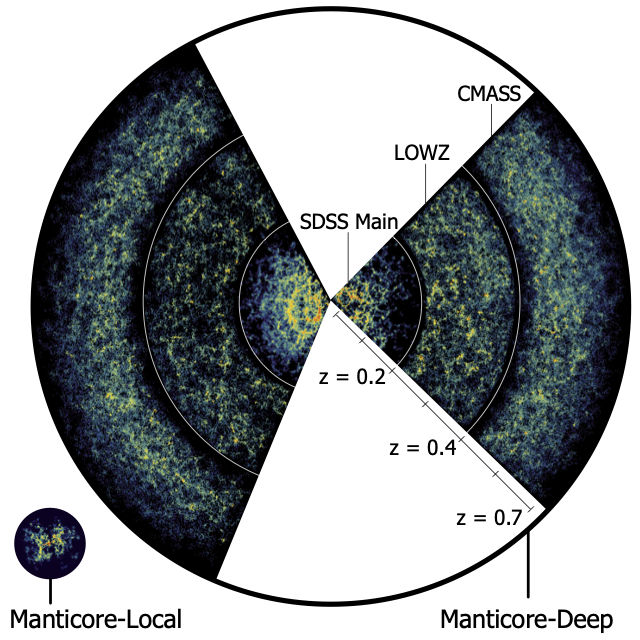
We present Manticore-Deep, a high-resolution Bayesian field-level inference of cosmic large-scale structure spanning a comoving volume of (4 h^-1Gpc)^3 out to z ≈ 0.7, at 4 h^-1 Mpc resolution. Building on the inference framework established in the companion Manticore-Local analysis (Paper I), Manticore-Deep jointly constrains five galaxy redshift surveys – 2M++, 6dFGS, 2dFGRS, SDSS, and BOSS – within a single hierarchical Bayesian framework using the BORG algorithm. The method infers primordial initial conditions that are evolved forward under gravitational dynamics, delivering a full posterior ensemble of three-dimensional density and velocity fields that causally reproduce the observed large-scale structure. A novel tiled inference strategy makes this computation feasible, extending the reconstructed volume by more than an order of magnitude beyond Paper I. The posterior realisations are statistically consistent with ΛCDM, exhibiting Gaussian, isotropic initial conditions and evolving into late-time structures that reproduce the expected z=0 matter power spectrum, bispectrum, and halo mass function across the resolved scales tested. We validate the physical fidelity of the reconstruction through two independent, template-free posterior-predictive tests against observations not used in the inference. Cross-correlation of the reconstructed matter field with the Planck PR3 CMB lensing map yields a conservative cumulative detection significance of 7.4 σ, while velocity-weighted stacking of 64,750 galaxy clusters on the Planck 217 GHz map produces a kinetic Sunyaev–Zel’dovich detection at 3.5 σ (median across the posterior ensemble), with a model-independent approach–recession split confirming that the inferred velocities are statistically aligned with the true cluster motions. Together, these tests demonstrate that Manticore-Deep recovers both projected-density and three-dimensional-velocity information and provides a causal, physics-based account of the observed large-scale structure. As a case study, we show that the BOSS Great Wall is recovered as a 3 σ overdensity consistent with ΛCDM across all posterior realisations. Manticore-Deep establishes a new benchmark for constrained cosmological digital twins at survey depth, and the field-level validation framework developed here provides reproducible, cross-method metrics for the next generation of large-scale structure reconstructions.
@article{2026arXiv260610020M,
  author = {{McAlpine}, Stuart and {Jasche}, Jens and {Lavaux}, Guilhem and {Doeser}, Ludvig and {Loureiro}, Arthur},
  title = {{The Manticore Project II: Bayesian digital twins of cosmic structure across the SDSS and BOSS volumes}},
  journal = {arXiv e-prints},
  keywords = {Cosmology and Nongalactic Astrophysics, Astrophysics of Galaxies},
  year = {2026},
  month = jun,
  eid = {arXiv:2606.10020},
  pages = {arXiv:2606.10020},
  archiveprefix = {arXiv},
  eprint = {2606.10020},
  primaryclass = {astro-ph.CO},
  adsurl = {https://ui.adsabs.harvard.edu/abs/2026arXiv260610020M},
  adsnote = {Provided by the SAO/NASA Astrophysics Data System},
}


arXiv links will be made available on this page once public. In the meantime, visit arXiv astro-ph to view recent papers.